
2025.02.14
- SLOW

- 2025년 2월 17일
- 3분 분량
Oil Prices Stabilize After Early Losses, Amid Delayed US Tariff Announcements
Oil prices ended flat on Thursday, recovering from early losses as U.S. tariff announcements were delayed until at least April, easing concerns about a trade war that could harm global economies and energy demand. Brent crude settled at $75.02 per barrel, down by 0.21%, while U.S. West Texas Intermediate (WTI) crude closed at $71.29 per barrel, down 0.11%. Earlier, oil prices dropped due to concerns that a potential peace deal between Russia and Ukraine might lead to an end of sanctions on Moscow, boosting global energy supplies. However, the delay in the U.S. tariff decisions sparked a price recovery, giving more time for negotiations. The market had also been pressured by news of rising U.S. crude inventories and a potential increase in Russian oil exports. Analysts noted that concerns shifted from tight oil supplies to fears of an oversupply, especially if Russia’s oil production continues to rise.
![[SLOW] Oil Market Benchmarks WTI, Dubai, and Brent](https://static.wixstatic.com/media/e9c525_e8e54ea2811043d6b4522a8fa1fb5240~mv2.png/v1/fill/w_631,h_681,al_c,q_90,enc_avif,quality_auto/e9c525_e8e54ea2811043d6b4522a8fa1fb5240~mv2.png)
__________________________________________________________________________________
US Sanctions Cause Major Disruption in Russia's Oil Tanker Fleet
Recent US sanctions have severely impacted Russia’s oil tanker fleet, with about 60% of the blacklisted vessels ceasing operations. This disruption has forced Russia to reorganize its supply chain, increasing freight costs and complicating crude deliveries. While oil production remains unaffected for now, major buyers like India, China, and Turkey are avoiding sanctioned shipments, creating logistical bottlenecks. Idled tankers are clustering in regions such as the Black Sea, the Baltic Sea, and Asia. Russia continues to export Arctic crude via Murmansk, but shipment routes are shifting, with some cargoes now heading toward China and Oman instead of India.
![[SLOW] https://slowspace.io/ Flow Filter _ Shadow Fleet](https://static.wixstatic.com/media/e9c525_155ee3780f874284afa73b808d140855~mv2.png/v1/fill/w_631,h_516,al_c,q_85,enc_avif,quality_auto/e9c525_155ee3780f874284afa73b808d140855~mv2.png)
__________________________________________________________________________________
Alternative Chinese Terminals Emerge to Accept Sanctioned Tankers
In response to U.S. sanctions on vessels carrying Russian and Iranian oil, newer Chinese terminals have started receiving sanctioned tankers, offering an alternative to Shandong Port Group, which banned such shipments in January. This ban affected independent Chinese refiners who buy Russian and Iranian crude, leading to fewer sanctioned oil deliveries. However, smaller terminals like those in Huizhou and Dongying have continued to receive oil, such as Russian ESPO Blend and Iranian crude. These terminals serve mainly for oil blending and transfer rather than direct refining. Despite sanctions, China remains a major buyer of Iranian and Russian oil, often disguising Iranian shipments as originating from Malaysia. China defends its trade with both countries and resists U.S. pressure, while Chinese refineries face rising costs due to these shifts in oil trade routes.
![[SLOW] https://slowspace.io/ Trade Flow China seaborne crude imports by destination facilities](https://static.wixstatic.com/media/e9c525_35c5f4abf3ef4e6a8acf82bcff1e9687~mv2.png/v1/fill/w_631,h_467,al_c,q_85,enc_avif,quality_auto/e9c525_35c5f4abf3ef4e6a8acf82bcff1e9687~mv2.png)
__________________________________________________________________________________
India to Continue Avoiding US-Sanctioned Russian Oil Tankers
India will only purchase Russian oil from suppliers and vessels not on the US sanctions list due to the risk of regulatory action, especially because Indian banks have exposure to the US economy. Since January, none of the newly blacklisted tankers have delivered Russian oil to India, but vessels sanctioned by the EU and UK have made deliveries. India, like China, continues to avoid dealing directly with US-designated vessels.
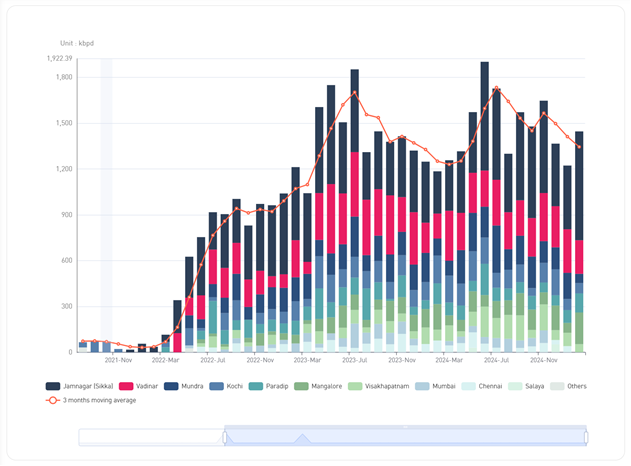
[SLOW] https://slowspace.io/ Trade Flow Russia seaborne crude exports to India by destination ports
__________________________________________________________________________________
VLCCs Dominate West African Crude Exports in January as Suezmax Market Declines
In January, VLCCs transported a record 56% of West Africa’s crude exports, an 18% increase year-on-year, as weak European demand due to seasonal refinery maintenance and stronger Asian interest in Atlantic crude over Dubai-linked grades drove the shift. Meanwhile, Suezmax tankers saw their market share drop to 40%, the lowest since July. Despite record liftings, VLCC earnings peaked at $60,000 per day in mid-January before falling 25% in a week. Market conditions remain weak, with freight rates under pressure, while Suezmax rates have held steady. Charterers are strategically holding back cargoes to prevent rate spikes, creating challenges for VLCC owners.
![[SLOW] VLCC Market Monitor](https://static.wixstatic.com/media/e9c525_c4b2ca25ed4041b8a3aff0c49b7f97db~mv2.png/v1/fill/w_631,h_784,al_c,q_90,enc_avif,quality_auto/e9c525_c4b2ca25ed4041b8a3aff0c49b7f97db~mv2.png)


댓글