
2025.02.10
- SLOW

- 2025년 2월 10일
- 4분 분량
Energy traders seek tariff waivers as VLCCs carry US crude to China
Energy traders are seeking waivers on Chinese tariffs as 12 VLCCs have been booked to transport U.S. crude to China. With the Chinese government imposing a 10% tariff on oil and a 15% tariff on gas imports in response to U.S. tariffs on Chinese exports, traders are looking for ways to avoid these extra levies, especially for cargoes already fixed. According to sources, these tariffs will impact shipments of West Texas Intermediate and Alaska North Slope crude, and several major companies including Vitol, Gunvor, ExxonMobil, and TotalEnergies have secured large tankers to ship the crude to China. Unipec, the trading arm of China’s Sinopec, is also involved in this business, with potential swaps between countries like Japan and Korea to mitigate the impact of the tariffs. While companies are seeking waivers for vessels already on route, it will be more challenging to secure waivers for cargoes booked after the tariff implementation date of February 10. Traders anticipate that the tariffs will have a limited impact on the tanker market since the U.S. supplies only about 200,000 barrels per day to China, which is a small fraction of China’s total crude imports. China is expected to rely more on oil from other regions like the Middle East Gulf, which would reduce the distance that oil needs to travel but could slightly decrease demand for U.S. oil in the long term.
![[SLOW] https://slowspace.io/ Trade Flow US seaborne crude exports to China by destination ports](https://static.wixstatic.com/media/e9c525_e0a9816a1d204ecc8fac61b23c4a68e4~mv2.png/v1/fill/w_980,h_725,al_c,q_90,usm_0.66_1.00_0.01,enc_avif,quality_auto/e9c525_e0a9816a1d204ecc8fac61b23c4a68e4~mv2.png)
------------------------------------------------------------------------------------------------
Oil prices decline for third week amid tariff concerns and market uncertainty
Oil prices ended higher on Friday after new U.S. sanctions on Iranian crude exports but still posted a weekly decline due to concerns over President Donald Trump's renewed trade war with China and potential tariffs on other countries. Brent crude settled at $74.66 per barrel, up 0.5%, while WTI rose to $71.00 per barrel, up 0.55%. However, worries over trade tensions and weakening global demand kept prices under pressure. Analysts noted that while sanctions typically boost oil prices, fears of an economic slowdown due to tariffs outweighed bullish factors. Traders closely watched Trump's statements, as shifts in U.S. trade and energy policies could impact markets swiftly.
![[SLOW] Oil Market Benchmarks WTI, Dubai, and Brent](https://static.wixstatic.com/media/e9c525_0303652a37d3401e9fa0fd9fd023df1c~mv2.png/v1/fill/w_593,h_731,al_c,q_90,enc_avif,quality_auto/e9c525_0303652a37d3401e9fa0fd9fd023df1c~mv2.png)
------------------------------------------------------------------------------------------------
Venezuela's PDVSA resumes light crude imports as domestic output declines
Venezuela's PDVSA has restarted light crude imports due to dwindling domestic production and a stalled swap deal with Iran. In December and January, two tankers offloaded crude at its main terminal, with one traced to China. January exports rose to 867,000 bpd, including 300,000 bpd to the U.S., despite potential trade restrictions. Crude output slightly increased to 1.05 million bpd, but blending struggles persist due to gas shortages and a damaged processing facility. Imports of Iranian crude and condensate have declined, while stable heavy naphtha imports from Chevron have helped sustain Orinoco Belt operations.
![[SLOW] https://slowspace.io/ Flow Jose crude terminal, Venezuela _ cargo flows](https://static.wixstatic.com/media/e9c525_36c5d6a53584484cbf3a22ad1bcaca4c~mv2.png/v1/fill/w_980,h_693,al_c,q_90,usm_0.66_1.00_0.01,enc_avif,quality_auto/e9c525_36c5d6a53584484cbf3a22ad1bcaca4c~mv2.png)
------------------------------------------------------------------------------------------------
Chevron accelerates Tengiz oilfield expansion, boosting Kazakh output
Chevron is fast-tracking the expansion of Kazakhstan's Tengiz oilfield, aiming to reach full capacity by June, with production already hitting 900,000 bpd—four months ahead of schedule. The $48 billion project, delayed since 2012, will raise output to nearly 1% of global crude supply. Tengiz oil is exported via the Caspian Pipeline Consortium. Kazakhstan’s increased production complicates OPEC+ output limits, though the government pledges compliance. Chevron holds a 50% stake in the Tengizchevroil joint venture, with ExxonMobil, KazMunayGas, and Lukoil also involved. The venture expects strong cash flow at current oil prices.
![[SLOW] https://slowspace.io/ Flow Tengiz oilfield _ Caspian pipeline](https://static.wixstatic.com/media/e9c525_a50333cb9df24e14bcc98bf9a344ea4e~mv2.png/v1/fill/w_980,h_434,al_c,q_90,usm_0.66_1.00_0.01,enc_avif,quality_auto/e9c525_a50333cb9df24e14bcc98bf9a344ea4e~mv2.png)
------------------------------------------------------------------------------------------------
Suncor plans night-time loading and to enhance crude shipments from Vancouver
Suncor is set to boost crude shipments from the Vancouver TMX pipeline terminal by introducing night-time loading of aframax tankers. This follows the completion of the TMX system expansion, which added 590,000 barrels per day to its existing capacity. The night-time loading initiative aims to increase the frequency of cargo shipments, with plans to raise monthly aframax cargoes from 30 to 34 by mid-2025. Additionally, dredging work under the Narrows Bridge in British Columbia will enable larger cargo ships to navigate the area. While the focus will be on expanding shipments to the U.S. West Coast, China, and South Korea, the use of VLCCs is not anticipated. These measures come in response to potential U.S. tariffs on Canadian oil, which could lead to longer-haul shipments to Asia.
![[SLOW] https://slowspace.io/ Trade Flow Canada seaborne crude exports by destination countries](https://static.wixstatic.com/media/e9c525_7580ed4d8e0f4b698e9219b2ec3dd3fa~mv2.png/v1/fill/w_980,h_724,al_c,q_90,usm_0.66_1.00_0.01,enc_avif,quality_auto/e9c525_7580ed4d8e0f4b698e9219b2ec3dd3fa~mv2.png)
------------------------------------------------------------------------------------------------
Kyoei Tanker sees huge profit surge after sale of veteran VLCC
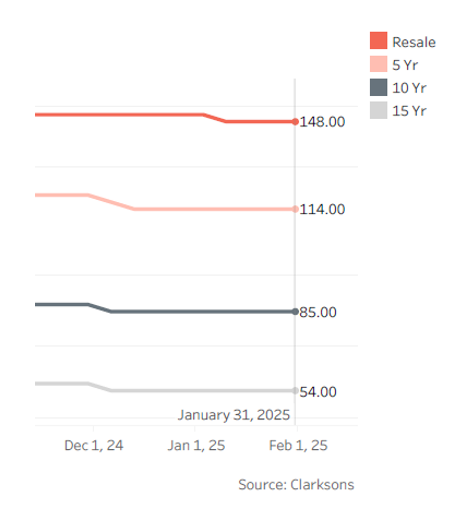
Japan’s Kyoei Tanker reported a significant profit increase for the nine months to March 31, 2024, driven by the sale of its oldest VLCC, Tohshi, for $44 million. Net profit surged to ¥4.9 billion ($32.2 million) from just ¥16 million the previous year, while revenue rose slightly to ¥11 billion. Despite increased costs due to the weak yen, the company reduced depreciation by cutting repair expenses. Kyoei, which owns a fleet valued at $829 million, has set its sights on fleet renewal, having already placed orders for two new VLCCs. The forecast for the full year shows a 34-fold profit increase.


댓글