
2024.11.28
- SLOW

- 2024년 12월 9일
- 4분 분량
U.S. Gasoline Inventories Surge Unexpectedly Before Thanksgiving Amid Declining Crude Imports
U.S. gasoline inventories unexpectedly rose by 3.3 million barrels to 212.2 million barrels last week, despite projections of a small draw, according to the Energy Information Administration (EIA).
This occurred as gasoline demand only slightly increased, even with anticipated record travel during Thanksgiving.
Crude oil stockpiles fell by 1.8 million barrels, triple the expected draw, due to a steep decline in imports, particularly from Mexico, which hit a record low of 151,000 barrels per day.
This marks the largest drop in Mexican imports since July 2020, attributed to declining production by Pemex and increased domestic refinery use.
Distillate stocks, including heating oil, also rose by 400,000 barrels, exceeding forecasts, while U.S. heating oil and gasoline futures dipped following the report.
Analysts noted the builds in refined products and the crude draw align with seasonal trends, reflecting a healthy oil market amid suppressed prices and low refining margins.

[SLOW] EIA - Crude Oil Outlook
------------------------------------------------------------------------------------------------
Saudi, Russia, and Kazakhstan Discuss Oil Policy Ahead of OPEC+ Meeting
Top OPEC+ members Saudi Arabia, Russia, and Kazakhstan held talks ahead of the weekend's policy-setting meeting, emphasizing the importance of adhering to voluntary oil production cuts.
Amid weaker global demand and rising non-OPEC+ output, the group is considering delaying a planned output increase set for January.
The increase, part of a gradual rollback of cuts, may now be postponed until the first quarter or later in 2025. Despite production cuts, Brent crude prices have remained in the $70-$80 range this year, with recent declines prompting speculation that cuts might extend into 2025. Analysts note that improved compliance among members supports modest price stability.
------------------------------------------------------------------------------------------------
"Oil Prices Steady Amid Surprising U.S. Gasoline Stock Increase and Geopolitical Concerns"
Oil prices remained mostly unchanged on Wednesday, pressured by a surprise rise in U.S. gasoline stocks and concerns over delayed interest rate cuts in the U.S. economy. Brent crude ended slightly higher at $72.83 per barrel, while U.S. West Texas Intermediate crude slipped to $68.72. The Energy Information Administration (EIA) reported a 3.3 million-barrel increase in U.S. gasoline stocks, defying expectations for a draw, while crude stocks fell by 1.8 million barrels. Market participants also reacted to U.S. inflation data, which suggested limited scope for future interest rate cuts.
On the geopolitical front, a ceasefire between Israel and Hezbollah, brokered by the U.S. and France, provided some support to oil prices amid concerns over supply disruptions. Additionally, OPEC+ is reportedly considering postponing planned oil output increases, which could tighten supply further. Oil analysts also pointed to the possibility of a market deficit and risks to supply from potential sanctions on Iran under the new U.S. administration.

[SLOW] Oil Market
------------------------------------------------------------------------------------------------
Asia May Gain Cheaper Oil if U.S. Imposes Tariffs on Canada, Mexico
If the U.S. imposes a 25% tariff on Canadian and Mexican crude, producers may lower prices and shift supply to Asia. The U.S. currently takes 61% of Canada's and 56% of Mexico's waterborne crude exports. Tariffs could strain U.S. refiners reliant on heavy crude, while Asian markets, particularly China and India, stand to benefit. European refiners are less likely to gain significant volumes. Analysts doubt the tariffs will proceed, citing inflation risks for U.S. consumers
------------------------------------------------------------------------------------------------
Russian Urals Oil Sales to Turkey Surge in November as STAR Refinery Resumes Operations
Russian Urals oil exports to Turkey rose 38% month-on-month in November, reaching 9.9 million barrels, as Turkey's STAR refinery resumed full operations after maintenance. The refinery, operated by Azerbaijan's SOCAR, increased its capacity by 2% to 260,000 barrels per day following its first major overhaul. STAR remains a key buyer of Urals crude, sourcing both spot and term contract volumes, with Lukoil as a major supplier.
Turkey continues to import Russian energy despite Western sanctions, while India accounted for over 60% of Urals oil arrivals in November. China's demand for Urals remains limited due to weak refining margins and slower economic growth, though it still prioritizes nearby Russian Far Eastern oil grades.

[SLOW] Trade Flow - From Russia To Turkey Monthly Trade Flow (CRUDE)
------------------------------------------------------------------------------------------------
Tanker Owners Face Prolonged Struggles as OPEC+ Likely to Extend Oil Production Cuts
Tanker markets, particularly for VLCCs, face further pressure as OPEC+ is expected to delay planned production increases, possibly until April 2025, according to source. This marks the third consecutive postponement of a production hike, with Saudi Arabia likely prioritizing price stability over output growth amid declining oil prices.
Weak oil demand from Asia and rising non-OPEC supply exacerbate challenges, with VLCC rates dropping on key routes, including Middle East to China, which fell to $26,946 per day. Analysts suggest that if production increases eventually proceed, they might trigger crude price drops, potentially encouraging stockpiling and boosting tanker demand via floating storage. However, for now, tanker owners must contend with a prolonged downturn in exports and freight rates.

[SLOW] Daily VLCC Market
------------------------------------------------------------------------------------------------
Eastern Pacific Shipping Sells Aframax Tanker and LPG Carrier Amid Fleet Renewal
Eastern Pacific Shipping, led by Idan Ofer, has sold its 11th vessel this year under a fleet renewal initiative as the company prepares for a wave of 120 newbuild deliveries over the next four years. Recent sales include the 105,200-dwt aframax tanker Serene Sea (built 2009) and the 37,000-cbm LPG carrier Nova Scotia (built 2016).
The Serene Sea was sold to Vietnam's PV Trans for $35.5 million, marking PV Trans' third aframax purchase this year. The Nova Scotia fetched $58 million, a strong price for a midsize LPG carrier, and was acquired by Italy's Carbofin, reportedly replacing an older vessel time chartered to Petrobras.
Eastern Pacific's fleet renewal strategy also involved the earlier sales of stainless steel chemical tankers, bulkers, and car carriers, highlighting the company's ongoing shift toward newer tonnage and modernized operations.
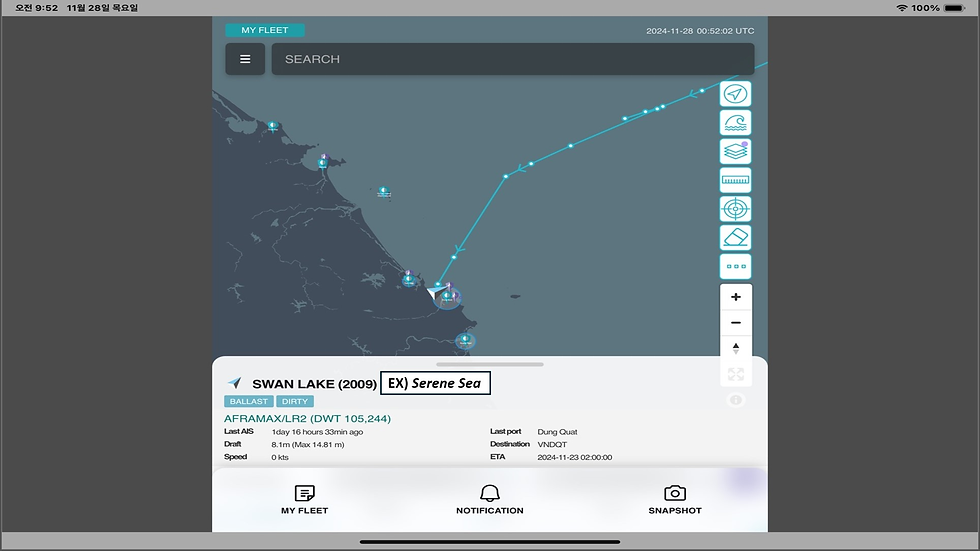
[SLOW] Flow - Slow mobile APP


댓글