
2024.10.16
- SLOW

- 2024년 10월 16일
- 3분 분량
Israel plans targeted strike on Iranian military sites, avoids oil facilities
Israel plans a targeted counterattack on Iranian military facilities, steering clear of oil and nuclear infrastructure, following a massive Iranian missile barrage on October 1. Israeli Prime Minister Benjamin Netanyahu assured U.S. President Joe Biden that the strike would avoid actions that might escalate into a broader conflict. The attack is anticipated before the U.S. elections on November 5, in response to public pressure for swift retaliation. The initial missile barrage caused fluctuations in tanker markets, with aframax rates surging 87% and suezmax rates rising 54% as fears of conflict and possible disruption to the Strait of Hormuz drove oil prices higher. However, tanker rates have since stabilized, and vessels have returned to Iran’s Kharg Island terminal.
------------------------------------------------------------------------------------------------

[SLOW] https://slowspace.io/ _ Bab el-Mandeb strait
Red Sea oil shipments plummet due to Houthi attacks, tanker traffic diverts to South Africa
Oil shipments through the Bab el-Mandeb strait at the southern entrance to the Red Sea dropped by more than half in the first eight months of 2024, falling to 4 million barrels per day (bpd) from 8.7 million bpd in 2023, according to the U.S. Energy Information Administration (EIA). This decline is linked to ongoing Houthi attacks on vessels in the region, forcing many tankers to take a longer route around South Africa's Cape of Good Hope, where volumes increased to 9.2 million bpd. Geopolitical tensions, including Iran's missile attacks on Israel, have heightened global oil price risks. The report also highlighted Western sanctions impacting Iranian oil production, though no 2024 figures were provided.
------------------------------------------------------------------------------------------------

[SLOW] https://slowspace.io/ FLOW SHIP FILTER _ SANCTIONED
Russia's $10bn shadow tanker fleet undermines sanctions, reduces western leverage
Russia has spent over $10 billion on secondhand tankers since 2022 to build a shadow fleet, allowing it to bypass the G7+ oil price cap and continue profiting from oil exports, according to a report from the Kyiv School of Economics (KSE). Nearly 70% of Russia's seaborne oil exports now use this fleet, which consists of older tankers stripped of ties to G7+ jurisdictions. The volume of oil transported by these vessels has surged to 4.1 million barrels per day by June 2024, significantly weakening the impact of Western sanctions. KSE researchers have identified about 1,000 vessels in the shadow fleet and compiled a list of priority tankers for potential sanctions.
------------------------------------------------------------------------------------------------
[SLOW] https://slowspace.io/ Trade Flow Russian seaborne oil exports by cargo group
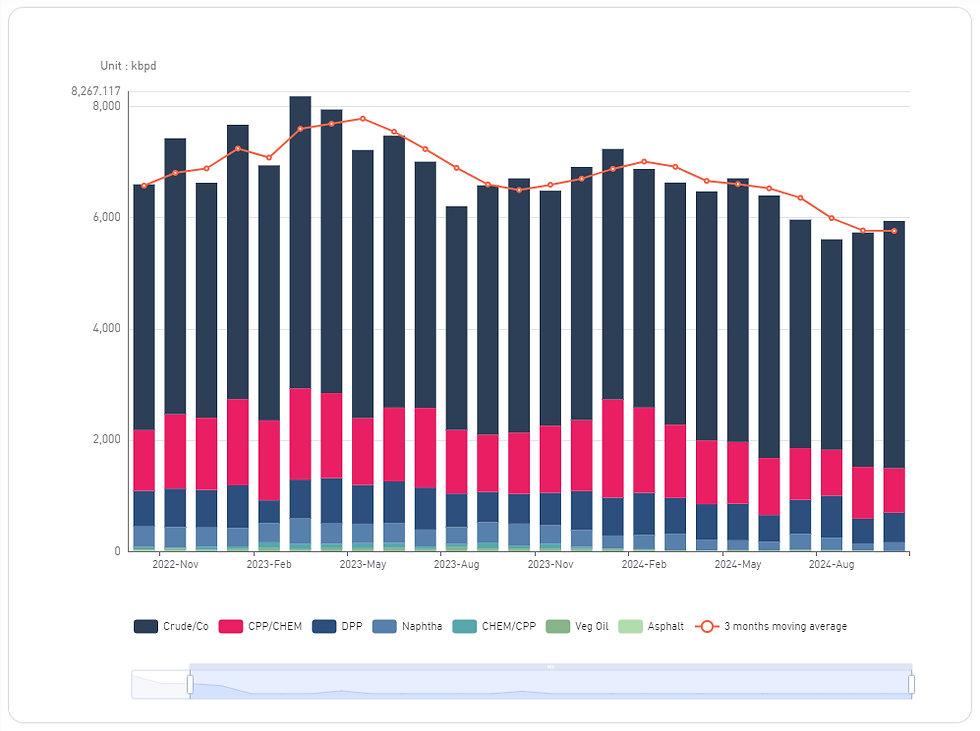
Russia increases fuel oil exports amid decline in diesel and naphtha flows
In early October, Russia's refined product exports hit a three-month high, driven by a significant rise in fuel oil shipments despite declines in diesel and naphtha flows. According to Vortexa Ltd. data, seaborne fuel oil flows reached 2.16 million barrels per day, marking a modest rise from the previous month and the highest level since July. This surge in fuel oil exports coincides with seasonal refinery maintenance, leading to reduced domestic oil processing and more crude available for export.
Diesel exports dropped 2% to 805,000 barrels per day, with cargoes mainly heading to Singapore, the UAE, and Turkey. Naphtha flows saw a steeper decline of 23% to 270,000 barrels per day, the lowest since 2016. Meanwhile, fuel oil exports surged by 16% to 843,000 barrels per day, with notable increases in shipments to Asia and the Middle East. The data also shows a 37% rise in shipments of refinery feedstocks like vacuum gasoil. Further revisions in cargo volumes and destinations are expected as more data becomes available.
------------------------------------------------------------------------------------------------

[SLOW] EIA - Crude Oil Outlook _ Russia
Russia has capacity to boost oil production by 700,000 barrels per day, IEA reports
According to the International Energy Agency (IEA), Russia has the potential to increase its crude oil production by up to 700,000 barrels per day (bpd). Russia’s sustainable capacity is estimated at 9.8 million bpd, excluding gas condensates, and this additional capacity could be reached within 90 days. The availability of spare capacity influences global oil prices, with a perception of ample capacity potentially curbing price increases. Currently, Russia's crude output is around 9.11 million bpd, slightly above its OPEC+ quota. However, OPEC noted that Russia reduced its output by 28,000 bpd in September, bringing production down to approximately 9 million bpd.


댓글